


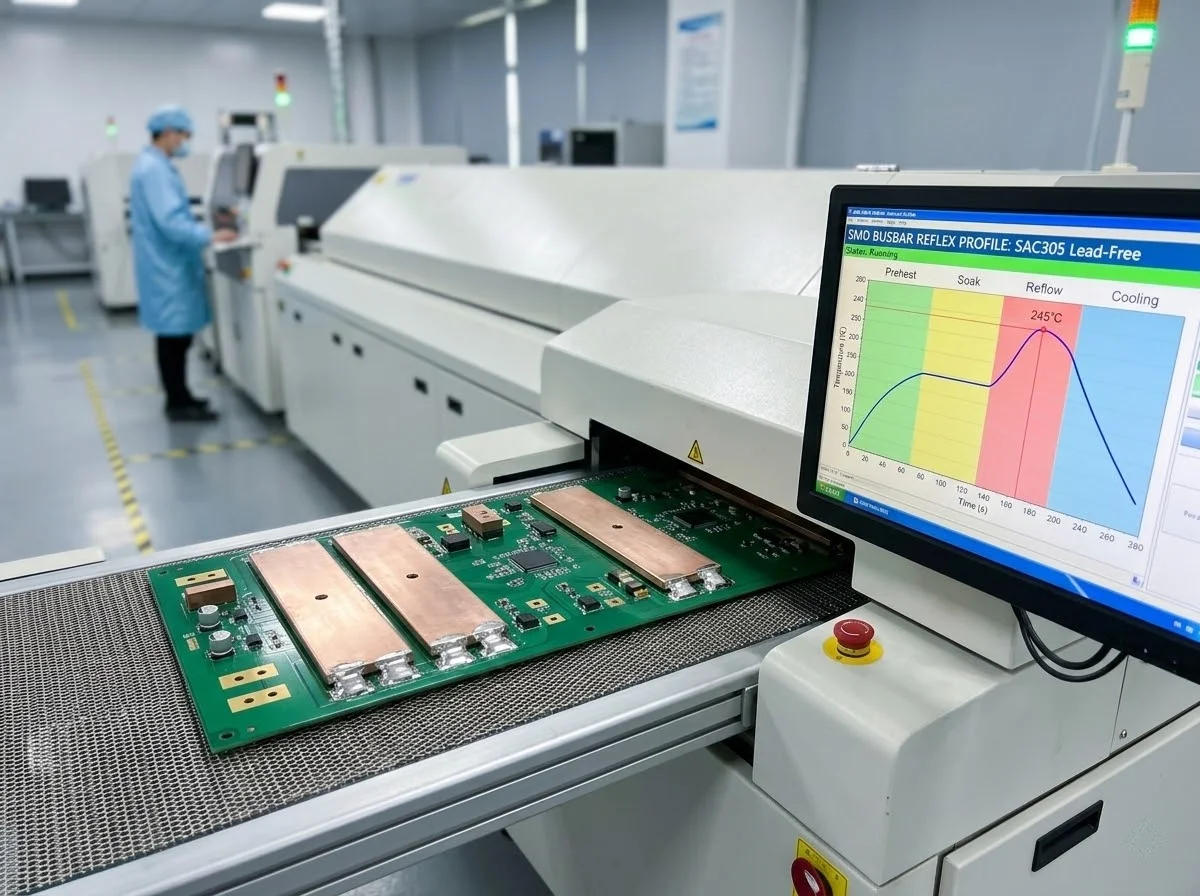
Essential Guide for Engineers: High Current SMD Busbar Reflow Soldering Process & Temperature Profile
With the rapid development of EV BMS (Battery Management Systems), PV inverters, and high-power server power supplies, SMD Busbars (Surface Mount Busbars) are increasingly utilized in PCB designs due to their exceptional current-carrying capacity. However, because pure copper has a large volume and a much higher thermal mass compared to standard SMT components, conventional reflow soldering parameters often lead to manufacturing defects such as cold solder joints or poor wetting. This article provides a detailed guide on the reflow soldering process requirements for high-current SMD busbars.
1. The Core Challenge: Overcoming Thermal Mass Differences
During SMT processing, an SMD busbar acts as a "heat sink". As it passes through the reflow oven, the copper bar heats up significantly slower than the surrounding small passive components and the PCB itself. If the thermal profile is not properly optimized, the solder paste under the busbar may not melt completely, resulting in poor reliability.
2. Recommended Reflow Temperature Profile
For standard lead-free solder paste (e.g., SAC305), we recommend optimizing your standard reflow profile as follows:
- 1. Preheat Zone: The ramp-up rate should be controlled at 1.0℃ ~ 3.0℃/s. Avoid heating too fast to prevent flux spattering and solder balling.
- 2. Soak Zone: This is the most critical stage! Maintain the temperature between 150℃ - 200℃ for 80 - 120 seconds. Extending the soak time is essential to allow the large copper busbar and the PCB pads to reach thermal equilibrium, minimizing the temperature delta.
- 3. Reflow Zone: The peak temperature should be set between 240℃ - 250℃. The Time Above Liquidus (TAL, typically >217℃) should be maintained for 50 - 90 seconds. Sufficient heat energy is required to ensure complete wetting of the solder joint.
- 4. Cooling Zone: The cool-down rate should be -1.0℃ ~ -5.0℃/s. Rapid cooling helps to refine the grain structure of the solder joint, enhancing mechanical strength.
3. Stencil and Solder Paste Recommendations
1. Stencil Design
Because SMD busbars carry high currents, a sufficient volume of solder paste is mandatory. We recommend a stencil thickness of 0.15mm - 0.2mm. For ultra-large surface mount busbars, using a Step Stencil (locally thickened) or expanding the pad apertures by 10%-15% is highly recommended to increase solder volume.
2. Solder Paste Selection
It is advisable to use high-activity, low-voiding lead-free solder pastes (such as SAC305 or SAC0307) to improve wetting on the copper substrate.
4. Troubleshooting Common Soldering Defects
- Cold Solder Joints: Usually caused by insufficient heat. Solution: Extend the soak zone duration or slightly increase the peak temperature.
- Component Shifting: This can be caused by incorrect pick-and-place nozzle pressure or uneven surface tension if the solder on two pads melts at different times. Solution: Ensure precise placement and optimize the soak zone to eliminate temperature differences across the board.
- High Voiding: Check for moisture absorption in the solder paste, or extend the soak zone to allow the flux to outgas completely.
5. Partner with a Premium SMD Busbar Manufacturer
Achieving a high SMT yield rate depends not only on the soldering process but also on the quality of the components. As a professional manufacturer of SMD Busbars, our products offer the following advantages:
- Strict Coplanarity: Excellent flatness ensures perfect contact with the PCB pads, facilitating uniform soldering.
- Premium Surface Plating: Available in matte tin, bright tin, and other platings, providing excellent oxidation resistance and solderability.
- Automation Friendly: Our full range of products supports standard Tape & Reel packaging, integrating seamlessly with high-speed SMT pick-and-place machines to maximize your production efficiency.
If you have any questions regarding high-current PCB design or SMD busbar selection, feel free to contact our engineering team for a free custom evaluation and technical support!