


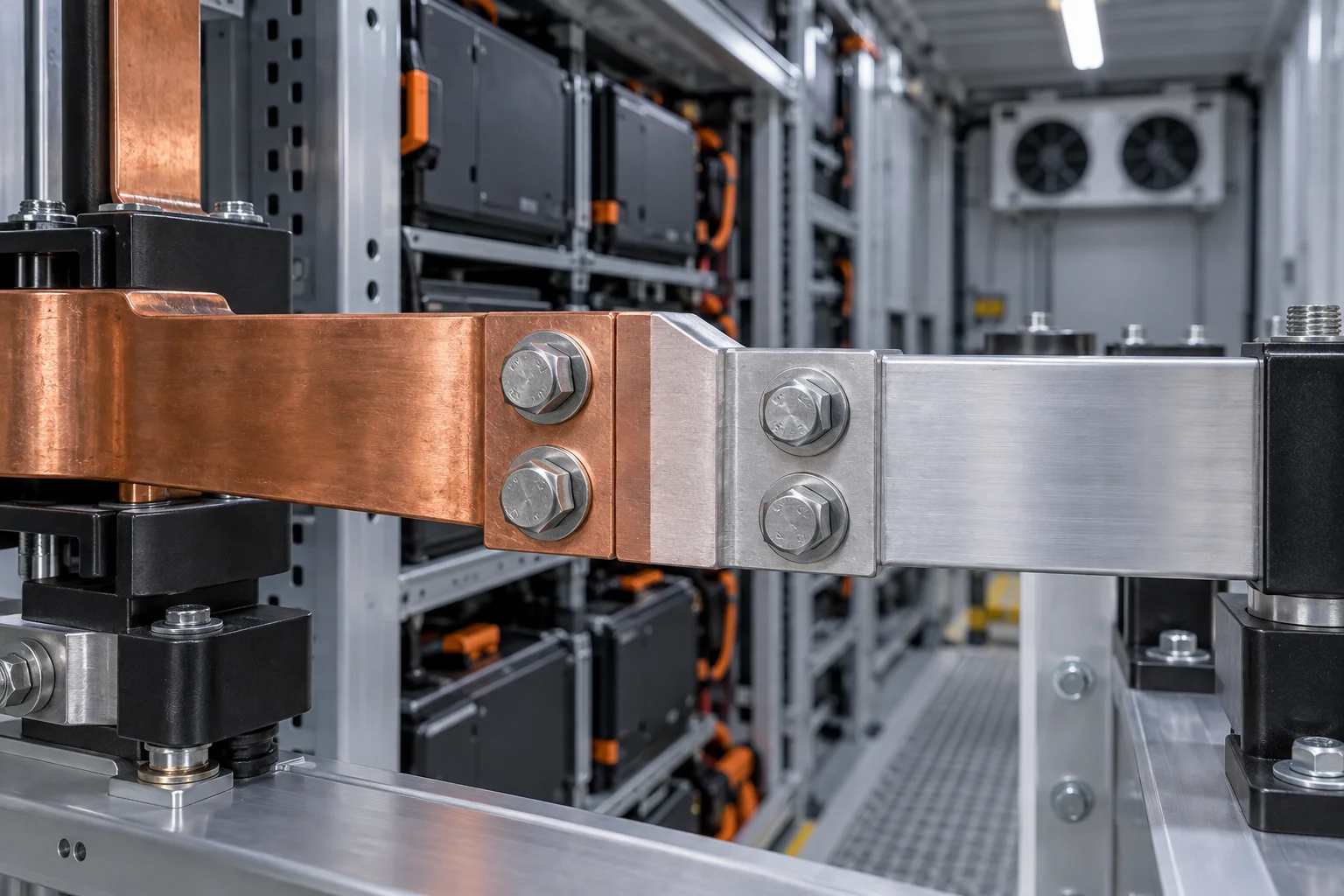
Quick answer: Select copper-aluminum connectors for a mobile energy-storage trailer by validating charge/discharge current, the bonded interface, bolt preload, road vibration, frame movement, temperature swing and condensation as one system. Compare resistance drift, fastener condition and hot-spot location before and after testing.
Questions answered
- Why are transition connectors used in mobile storage?
- How does road vibration affect preload?
- How is galvanic corrosion controlled?
- How are low resistance and temperature measured?
- What needs inspection after arrival?
Application context
Battery racks, combiner cabinets, PCS equipment and external interfaces can mix copper bars, aluminum bars and cables. A copper-aluminum connector manages the material transition, but the joint needs independent support so bus movement and frame twist do not load the bonded zone.
Five controls
| Control | Review | Risk |
|---|---|---|
| Interface | Area, edge, flatness and non-destructive inspection | Separation or resistance drift |
| Preload | Bolt, washer, hole, torque and locking | Relaxation and fretting |
| Current | Continuous/peak, SOC range and cycle time | Local heat |
| Mechanical | Transport spectrum, supports and frame movement | Loaded interface |
| Environment | Condensation, salt, drainage and coating boundary | Galvanic corrosion |
Resistance, temperature and transport testing
Use a fixed four-wire current, polarity and measurement points across the copper side, transition, aluminum side and bolted joint. Repeat after realistic cycling, road vibration, thermal cycling and damp heat. Measure interface edges, fasteners, insulators and adjacent bars. Use this interface separation guide when qualifying the bonded zone.
FAQ
Does a locking nut remove torque reinspection?
No. Thermal cycling, material creep and transport vibration can still change clamp load.
Can protective coating cover the contact?
An insulating coating should not enter the intended conductive area.
What belongs in an RFQ?
Provide alloys, section, pitch, current profile, fasteners, torque, vibration and environment. Start with the connector page.