


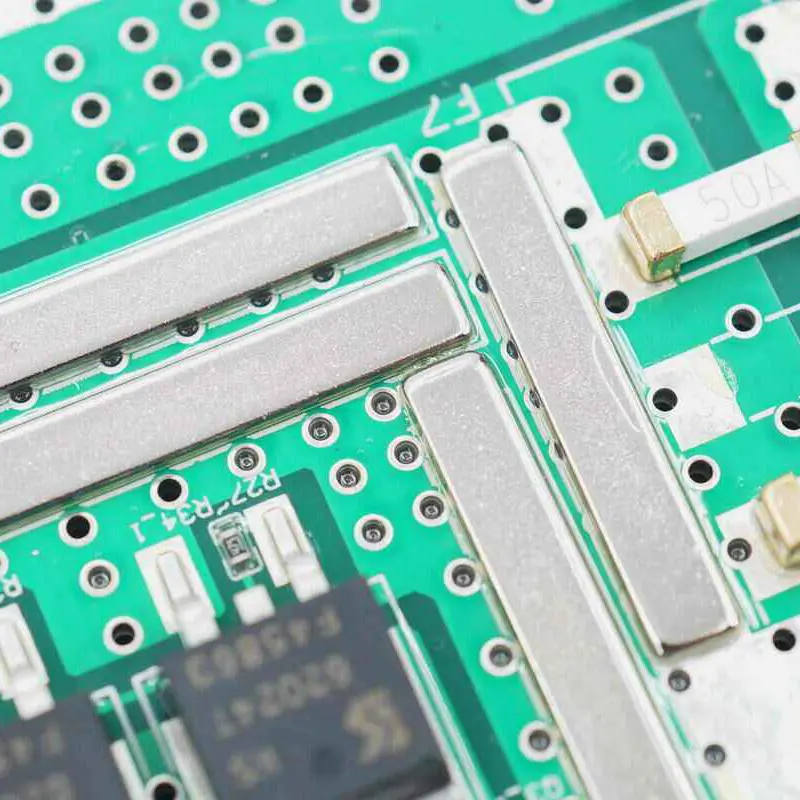
In an industrial control cabinet, a busbar usually deserves earlier consideration than a wire harness when the conductive path is fixed, space is tight, and the project needs better assembly consistency. The real question is not which connection type feels more advanced. It is whether that path should become a clear, stable, and repeatable current route.
For projects that involve VFDs, PLC cabinets, and servo drives at the same time, it helps to review the SMD busbar page, applications page, and selection guide page together. That makes it easier to judge product options, application positions, and structural limits inside one framework instead of choosing material or wiring style only by habit.
Why busbars often deserve a fresh look in industrial control cabinets
Not every conductive path inside a cabinet plays the same role. Some paths handle main power entry and distribution. Some serve as fixed transitions between modules. Others need flexible routing, longer distance, or easier service access. When the first two cases dominate, a busbar often makes the cabinet layout clearer and easier to repeat than a harness.
- The main power path is fixed and the connection points are already clear.
- Cabinet space is limited and the design wants fewer detours and transitions.
- Production needs better assembly rhythm and repeatability.
- The project wants cleaner power distribution for engineering review and maintenance.
Which positions in VFDs, PLC cabinets, and servo drives deserve busbar review first
| Typical position | Why a busbar fits better | Main design focus |
|---|---|---|
| Main power entry and distribution node | The path is fixed and can be organized as a clear board-level or in-cabinet current route | Spacing, mounting direction, and end connection method |
| Fixed internal transition inside a VFD or servo drive | Needs a more compact conductive structure and steadier assembly repeatability | Cross-section, heat spreading, and nearby component space |
| Power distribution area for side-by-side modules | Helps make distribution logic neater and reduces routing detours | Module tolerance, service access, and insulation design |
When a wire harness still makes more sense
A harness does not lose value just because a busbar is more rigid. When the path is longer, needs flexible routing, or must support door movement, slide-out modules, or vibration buffering, a harness is often the more natural choice. In practice, the best solution is rarely choosing one for everything. It is assigning the right role to each section of the conductive path.
| Approach | Best role | Main caution |
|---|---|---|
| Busbar | Fixed, compact conductive paths that need better consistency | Structure space, insulation, and mounting direction need early review |
| Wire harness | Longer routes, flexible detours, or positions with maintenance movement | The path is flexible, but space use and assembly consistency still matter |
| Terminal or connector | Interface transitions, external conductor entry, and local fastening points | Good for interface management, not always for the full main path |
Five questions to answer before selecting
1. Is this current path fixed for the long term
If the structure already defines the route clearly and mass production will not need frequent directional changes, a busbar has a better chance to create value. If the route still changes often because of redesign or service movement, a harness is usually more forgiving.
2. Is cabinet space more limited by height conflicts or by routing detours
A busbar can tighten the path, but it also needs explicit section and mounting space. The team should judge whether the project is more constrained by part interference or by the space lost to harness routing.
3. What kind of service action happens between modules
If modules need frequent removal, sliding, or replacement, flexible connections are usually friendlier. If the connection position stays fixed and service action is limited, a busbar often keeps structure and power distribution cleaner.
4. Does the project prioritize consistency or routing freedom
When production cares more about assembly rhythm and repeatability, a busbar becomes more attractive. When the project is still in a prototype-heavy stage with frequent layout changes, the adaptability of a harness may still matter more.
5. Can temperature rise and transition count be optimized together
In cabinet power distribution, teams should not look at conductor section alone. They should also review how many transition points exist, how current changes direction, and how heat spreads. A clearer path usually makes hidden risk easier to see earlier.
A more practical decision sequence
- Separate the cabinet's main current paths from the auxiliary paths first.
- Confirm which sections are fixed and which need flexible movement.
- Compare layout space, service action, and assembly consistency needs.
- Then assign busbars, harnesses, or terminals to the positions that fit them best.
FAQ
Does a PLC cabinet always have no need for busbars?
No. If a PLC cabinet includes a defined power-distribution section, a fixed inter-board transition, or a side-by-side module power area, a busbar can still be worth evaluating. Signal routing, low-current paths, and positions that need flexible wiring are where harnesses usually remain more natural.
Inside a VFD or servo drive, should everything use harnesses or everything use busbars?
Usually neither. A more practical approach is to let fixed high-current paths use busbars and leave flexible transitions or service-related movement to harnesses or terminals.
What is the easiest thing to miss in industrial cabinet busbar selection?
The easiest miss is delaying service action and mounting direction until too late. Many ideas make sense electrically but expose space and operation problems during real assembly or maintenance.
Conclusion
Selecting a busbar in an industrial control cabinet is not about replacing harnesses everywhere. It is about giving fixed paths, flexible paths, and interface paths the connection method that actually fits each one. Once current route, service action, and space limits are separated clearly, the conductive design inside VFDs, PLC cabinets, and servo drives usually converges much faster.