

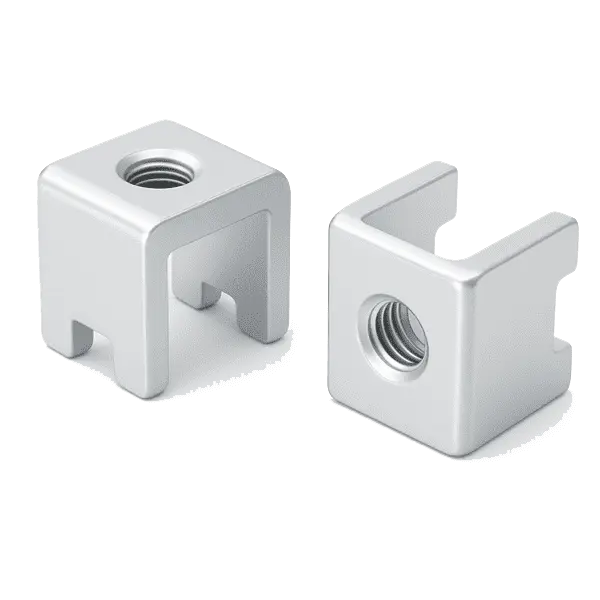
If your EV PDU has already moved into high-voltage distribution-box integration and modular service design, a welding terminal is often worth evaluating before improvised flying wires or overly scattered connection methods. Its main value is not only carrying current. It helps standardize the high-voltage main path, fuse protection, and later service action together.
For projects that care about high-voltage safety, assembly consistency, and after-sales maintenance at the same time, it helps to review the welding terminal page, applications page, and busbar page together. That makes it easier to keep fixed high-current short paths on busbars and give module interfaces and serviceable nodes to welding terminals instead of forcing one connection form to do everything.
Why EV PDUs often need welding terminals
The challenge inside a PDU is usually not conductivity alone. The high-voltage main path, fuse links, pre-charge loop, and sensing interfaces are all compressed into a tighter space. In this kind of structure, welding terminals fit well where the team needs clearer board-level interface definition, controlled fastening direction, and standardized maintenance action.
- Useful for making the internal board-level interfaces in the high-voltage distribution box clearer.
- Useful for giving fuse protection and sensing branches clearer connection boundaries.
- Useful for production programs that expect repeated service or module replacement.
- Useful for reducing harness adjustment and assembly variation.
Which positions deserve welding terminals first
| Application point | Why a terminal fits | Main design focus |
|---|---|---|
| High-voltage main-path interface | Helps separate the board-level interface from downstream busbar or cable transition | Current cross-section, insulation spacing, and load path |
| Fuse and protection-branch connection point | Helps define the installation direction and maintenance order of protection devices | Fastening space, nearby component spacing, and service access |
| Positions with higher module replacement frequency | Helps create a more repeatable disassembly logic | Tool space, repeat fastening stability, and structural support |
When a welding terminal may not be the first choice
If a path is fundamentally a fixed high-current short route, a busbar is usually more natural. If a connection must travel farther and needs flexible detours, a harness may still be better. A welding terminal is strongest when it handles board-level interfaces and serviceable connection points instead of replacing every conductive path.
| Approach | Best role | Main caution |
|---|---|---|
| Welding terminal | Board-level interfaces, protection-branch points, and serviceable nodes | Confirm insulation spacing, soldering window, and fastening order early |
| Busbar | Fixed high-current short paths and distribution nodes | Best for main paths, but service action still needs review |
| Harness | Longer detours, more movement, or connections whose interface is not fully fixed yet | Flexible, but space use and repeatability must be checked |
Five questions to answer before selecting
1. Does the terminal carry the main path or mainly the interface transition
If the terminal mainly handles interface transition, mounting direction, solder area, and fastening space usually matter more than simply enlarging the size. If it also carries the main path, cross-section, heat spreading, and load path should be reviewed together.
2. Will insulation needs conflict with maintenance action
A high-voltage PDU cannot be judged by current alone. The team must confirm whether insulation spacing and service space can both work. If the terminal area is crowded and also needs frequent maintenance, problems appear later during assembly and field service.
3. Is the service sequence of fuse protection parts clear enough
In many PDU programs, the problem is not the part itself. It is that protection parts, fastening positions, and tool direction were never organized clearly. If the welding terminal is placed in a poor maintenance position, later replacement becomes harder.
4. Will cable pull and mechanical tolerance feed stress back into the solder joint
If downstream cables are not fixed well, or enclosure tolerance is not absorbed elsewhere, the load usually returns to the solder joint and interface structure. This issue often shows up earlier than current-rating limits.
5. Does the project prioritize extreme compactness or replacement efficiency
If the system pushes for maximum compactness, terminal layout becomes denser. If the project values after-sales replacement speed more, realistic room must remain for insulation, protection parts, and tool action.
A more practical decision sequence
- Separate the main path, protection branches, and sensing or auxiliary interfaces first.
- Confirm which positions need fixed high-current short paths and which need serviceable interfaces.
- Review insulation spacing, soldering window, fastening direction, and load path together.
- Then decide which segments should be handled by welding terminals, busbars, and harnesses.
FAQ
Does every EV PDU need welding terminals?
No. If the structure is simple and service needs are low, other connection methods may still work. But when the project values clear board-level interfaces, high-voltage protection logic, and production consistency, welding terminals usually deserve earlier evaluation.
Can a welding terminal replace a busbar?
At some interface points, yes. But it is usually not a good idea to let terminals carry every fixed high-current short path. A more practical arrangement is to let busbars carry the main path and let welding terminals handle transitions and service nodes.
What is easiest to miss in this kind of project?
The easiest miss is delaying insulation spacing, maintenance action, and cable-load review. Many concepts work in prototype builds but expose structural risk in production and after-sales service.
Conclusion
Selecting welding terminals for an EV PDU is not about choosing one terminal in isolation. The real goal is making the high-voltage main path, fuse protection, insulation layout, and service action work together. Once path division, load control, and service order are clarified early, the system-level solution usually stabilizes much faster.