


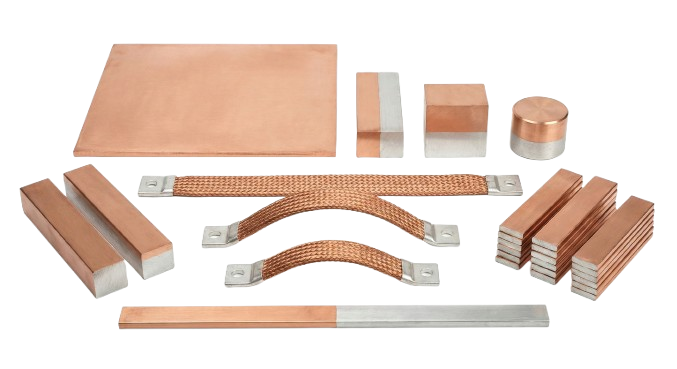
If your project is building a large-section current path and is also under pressure from weight, raw material cost, or oversized conductive structures, a copper-aluminum composite busbar deserves early evaluation. Its value is not simply replacing copper with aluminum. The real point is to find a more workable balance between conductivity, weight, cost, and manufacturing fit.
At the same time, a Cu-Al eutectic busbar is not the default answer for every project. The first questions should be how long the current path is, which areas must keep the highest conductivity and interface reliability, and what bending, joining, and assembly steps still need to happen later. Reviewing the Cu-Al eutectic busbar page, SMD busbar page, and support page together is usually more useful than focusing on one material alone.
When a copper-aluminum composite busbar deserves a spot on the shortlist
As conductive parts become larger and longer, a full-copper solution often increases both weight and raw material pressure. In those cases, the meaning of a copper-aluminum composite option is to create more room for structure and cost control without losing sight of the core conductive goal.
- The conductive path is longer or larger in section, making full-copper weight and cost harder to control.
- The project needs to balance conductivity with lightweight targets.
- Forming, bending, and assembly decisions need to be considered earlier in the material choice.
- The engineering team wants to compare material strategies during sampling instead of switching late.
Five questions to confirm first
1. Which areas should still follow a full-copper mindset
Not every part of the conductive path needs the same material logic. If some positions carry concentrated current, repeated fastening, or critical interfaces, teams usually evaluate those sections separately first and only then decide whether other sections are better suited to a composite approach.
2. Has path length and section size already made full copper expensive enough to matter
If the part is only a short connection with limited size, full copper is often the more direct solution. But when the conductor becomes longer, wider, or more numerous, the material decision starts to affect total weight, purchasing pressure, and structure handling much more clearly. That is when the value of a composite option increases.
3. Which balance matters most: conductivity, weight, or cost
The selection logic for a copper-aluminum composite busbar is never about one number alone. It depends on what the project is really optimizing. If the goal is to keep as much full-copper margin as possible, the answer will look different. If the goal is to bring weight and cost into the design decision as well, composite material becomes more attractive.
4. Do forming, bending, and downstream joining methods fit the material plan
The current site positions the Cu-Al eutectic busbar as a material produced by solid-liquid cast-rolling. For engineering teams, the more practical question is whether the needed bends, holes, assembly actions, and interface design are compatible with the planned material approach instead of judging by material name alone.
5. Is the sample-validation plan close enough to real operating conditions
The biggest risk in this type of material decision is relying too much on paper judgment and too little on realistic validation. A safer approach is to evaluate samples against the true current path, interface structure, and assembly method as early as possible.
When to prioritize a Cu-Al eutectic busbar and when to keep full copper
| Project situation | Better first option | Why |
|---|---|---|
| Larger conductor size with obvious weight and raw material pressure | Copper-aluminum composite busbar | It gives more room to optimize both weight and material cost |
| Short conductive path, simple structure, and priority on quick implementation | Full-copper busbar | The solution is more direct and easier to judge |
| High-demand interface area where local connection reliability matters most | Segment-by-segment evaluation | Critical interfaces and the main path may not need the same material strategy |
| Early sample stage where several material directions are still open | Evaluate both composite and full copper in parallel | It is easier to find the overall better solution early |
Common decision scenarios in new energy and power equipment
| Application scenario | Main concern | Evaluation focus |
|---|---|---|
| Energy storage and power distribution equipment | Longer current paths and larger structural conductors | Balance of weight, cost, and assembly space |
| New energy busbar systems | Need to carry current while managing structure size | Material combination and interface design |
| Power equipment connectors | Desire to reduce overall material pressure | Sample validation, interface positions, and forming method |
Points engineering teams often miss
- Comparing only unit material price instead of the full conductive path structure.
- Looking only at theoretical conductivity without checking forming, assembly, and interface fit.
- Applying one material mindset to every section and ignoring special interface requirements.
- Running sample validation too far away from the real structure, which weakens the final decision.
A more practical selection sequence
- Break down the full conductive path and identify which sections are most sensitive.
- Decide whether weight, cost, or interface reliability is the stronger current constraint.
- Evaluate material strategy together with forming, bending, and assembly method.
- Use realistic sample validation to narrow the final solution.
FAQ
Is a copper-aluminum composite busbar a direct replacement for full copper?
No. It is a solution that needs to be judged within the real conductive path and interface conditions. It can be very useful in the right scenario and should not be forced into the wrong one.
When is it unnecessary to add a composite option to the discussion?
If the conductor is not large, the structure is simple, and the main priority is quick implementation rather than weight and cost optimization, a full-copper approach is usually more straightforward.
What should be validated first in a composite-busbar project?
The first priority is not a paper value alone, but how the material behaves in the real interface, bending, assembly, and conductive-path context. That is what makes the conclusion usable.
Conclusion
Selecting a copper-aluminum composite busbar is not a simple yes-or-no replacement question. It is a decision about whether the project truly needs to rebalance conductivity, weight, cost, and manufacturing method. Once path, interface, and validation plan are separated clearly, it becomes much easier to judge where a Cu-Al eutectic busbar can create real value.