


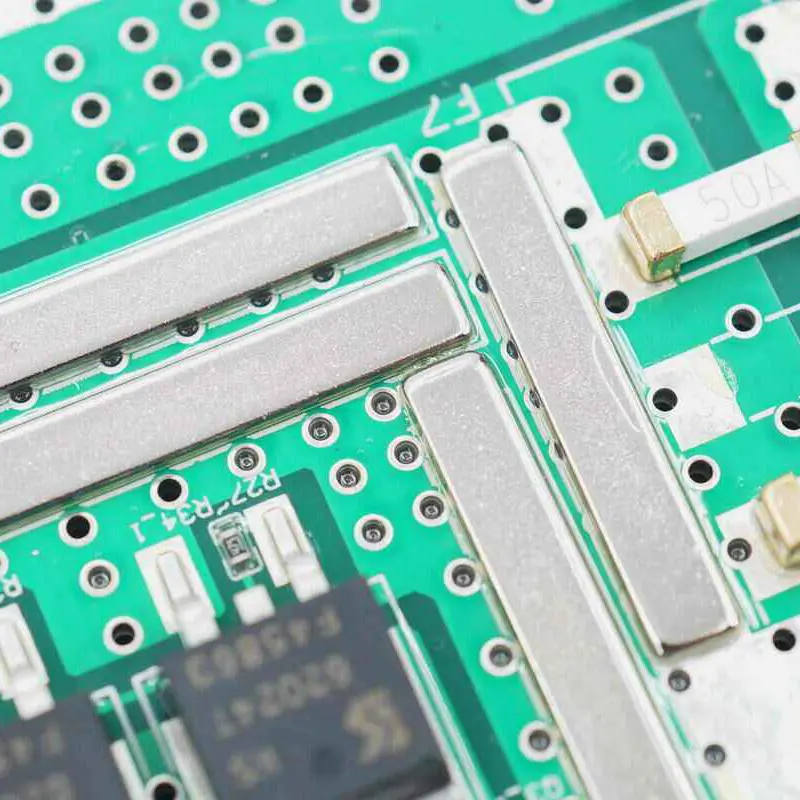
If your charging-station cabinet has already moved into multi-module paralleling and high power-density layout, a busbar is often worth evaluating before long wire harnesses. What it really solves is not only conductivity. It helps standardize the main bus path, the module-paralleling relationship, and the later maintenance action.
For projects that care about current path, installation efficiency, and serviceability at the same time, it helps to review the busbar page, applications page, and welding terminal page together. That makes it easier to give fixed short paths to busbars, interface transitions to terminals, and only the necessary flexible detours to harnesses.
Why charging-station power distribution often needs busbars
The common problem inside a charging station is not whether one point can conduct current. It is whether the main bus stays short after multiple modules are paralleled, whether temperature rise remains under control, and whether later module replacement is practical. Busbars fit best between fixed high-current short paths and repeat-service nodes.
- Useful for making the main path after rectifier-module paralleling clearer.
- Useful for reducing the space use and routing variation of long harnesses.
- Useful for making current distribution, fastening order, and structure easier to repeat.
- Useful in high power-density cabinets that must control temperature rise and preserve service space.
Which positions deserve busbars first
| Application point | Why a busbar fits | Main design focus |
|---|---|---|
| Main bus for paralleled rectifier modules | Helps shorten the parallel path and reduce layout disorder | Cross-section, current sharing, and fixing method |
| Power-distribution node | Helps separate the main path from branch interfaces clearly | Insulation spacing, installation order, and marking |
| Cabinet areas with higher module replacement frequency | Helps standardize fixed paths and maintenance action | Tool space, fastening order, and service access |
When a busbar may not be the first choice
If a path is longer, needs flexible detours, or the structure is still changing often, a harness usually stays more practical. If a point mainly acts as an interface transition, a welding terminal may fit better. A busbar is strongest when it handles fixed high-current short paths rather than every connection form in the cabinet.
| Approach | Best role | Main caution |
|---|---|---|
| Busbar | Fixed high-current short paths, parallel main buses, and distribution nodes | Confirm cross-section, temperature rise, insulation, and service action early |
| Welding terminal | Board-level interfaces, module-output transitions, and serviceable interfaces | Better for interface definition, not always for the full main path |
| Harness | Positions needing detours, more movement, or unfinished structure | Flexible in routing, but repeatability and space use still need review |
Five questions to answer before selecting
1. How short is the main path between paralleled modules really
If the link between modules is fundamentally a fixed short path, a busbar is usually the more natural fit. If the path is already long or must pass around multiple structures, the team should review whether a rigid conductor still makes sense.
2. Does temperature rise come from insufficient cross-section or overly dense layout
In many charging-station programs, the problem is not only conductor size. It is also heat stacking after multiple modules are packed together. Adding more copper alone often brings limited benefit if layout and airflow stay unchanged.
3. Will the bus structure block maintenance action
Modular charging stations often need replacement of power modules, fuses, or monitoring parts. If the busbar only pursues the shortest path and ignores tool space and service sequence, maintenance cost rises quickly.
4. Can insulation and fixation work at the same time
The more concentrated the high-current path becomes, the less the team can check conductivity alone. Support structure, insulation distance, and fixing positions all need joint review, or installation and withstand-voltage risks appear later.
5. Does the project prioritize extreme compactness or faster service
If the system pushes for maximum compactness, busbar layout becomes more aggressive. If the project values field-service efficiency more, enough room should remain for fastening and replacement actions.
A more practical decision sequence
- Separate the main bus, distribution nodes, and interface transition points first.
- Confirm which positions must use short and fixed high-current paths.
- Review cross-section, temperature rise, insulation, and service space together.
- Then decide which segments should be handled by busbars, terminals, and harnesses.
FAQ
Does charging-station power distribution always need busbars?
No. If the power level is moderate and the structure is loose, a harness may still work. But once the project moves into multi-module paralleling, high power density, and long-term maintenance, busbars usually deserve earlier priority.
Can a busbar replace every connector?
Usually not. A more practical arrangement is to let the busbar handle the fixed main path, let terminals handle interface transitions, and let harnesses handle detours and flexible connections.
What is easiest to miss in this type of project?
The easiest miss is checking current alone while delaying maintenance action and insulation fixation review. Many concepts work electrically but expose structural problems during installation and field service.
Conclusion
Selecting a busbar for charging-station power distribution is not only about increasing copper cross-section. The real goal is making the parallel main bus, temperature-rise control, insulation layout, and maintenance action work together. Once current path, structural support, and service action are clarified early, the system-level solution usually stabilizes much faster.