


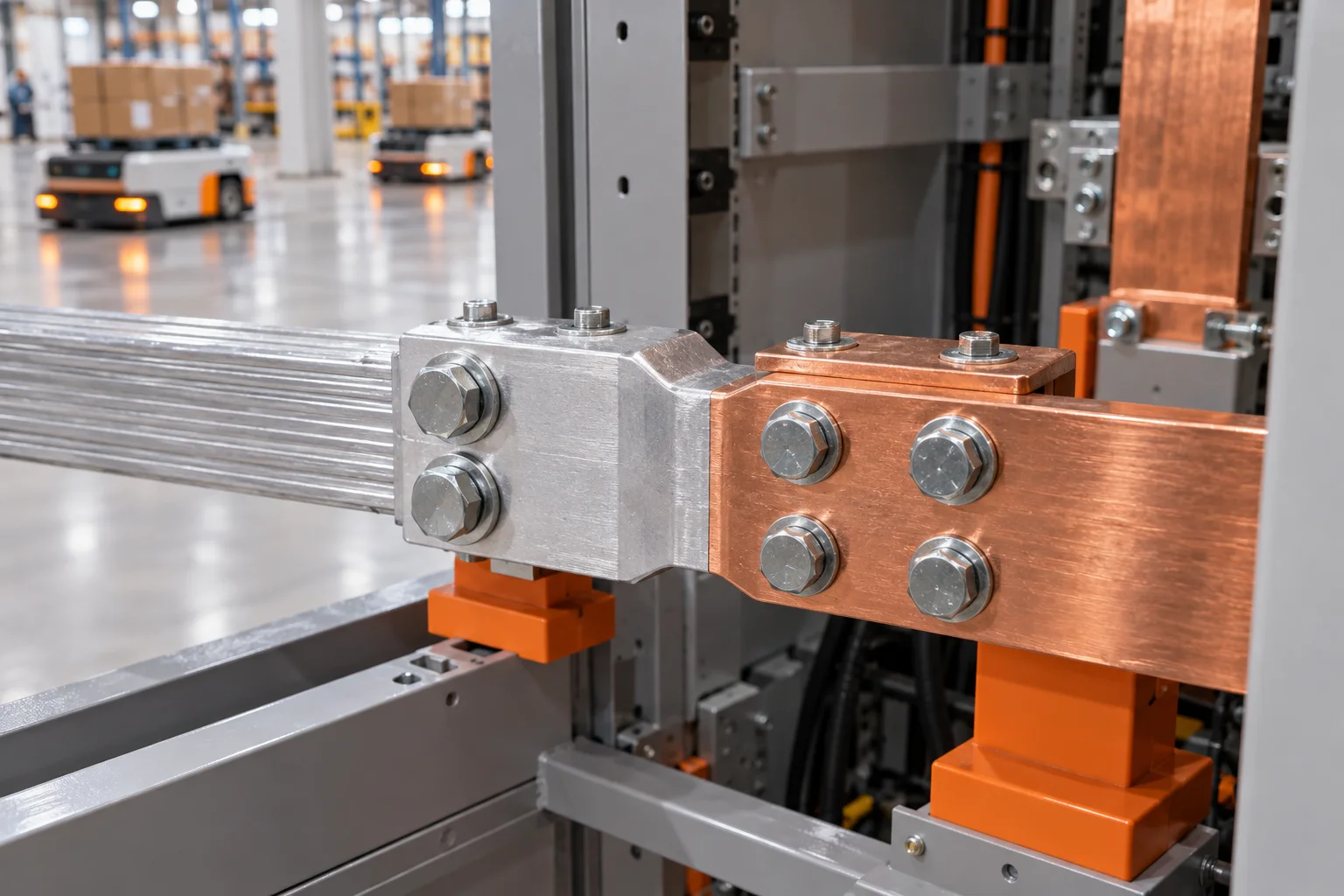
Quick answer: Select a copper-aluminum connector for an AGV fast charger by validating frequent charge cycling, the transition interface, bolt and washer system, cable support, warehouse dust and service reassembly. Low initial resistance does not prove stable preload after thermal cycling.
Questions answered on this page
- Why use copper-aluminum transition hardware in an AGV charger?
- How do frequent charge cycles affect contact resistance?
- How do bolts, washers and supports retain pressure?
- How do dust, moisture and cleaner affect corrosion?
- Which values must be repeated after service?
Application context
Fast-charging cabinets connect rectifier modules, DC buses and battery or supercapacitor interfaces. Copper bars, aluminum bars, copper terminals and aluminum housings may coexist. Transition hardware manages the material change and compact layout, while cable mass and robot docking loads require independent support. Hongchuan supplies copper-aluminum connectors matched to alloy, interface, section, pitch, current profile, bolts, washers, torque and environment.
Five reliability controls
| Control | Review | Risk |
|---|---|---|
| Interface | Composite zone, area and edge condition | Resistance drift or separation |
| Preload | Bolt, washer, hole and torque window | Thermal relaxation |
| Current | Continuous, peak, cycle rate and drop | Local heating |
| Environment | Dust, moisture, cleaner and condensation | Galvanic corrosion |
| Mechanical | Cable, bar support and docking impact | Loaded interface |
Resistance and temperature under cycling
At cold start, rated charge, peak charge, short-interval repeated charging and maximum cabinet temperature, measure copper, aluminum, transition, bolt, washer and insulation. Record four-wire joint drop with the same current and points before and after cycling. Use this interface separation guide when validating composite structure.
Corrosion and service reassembly
Inspect oxide, hole indentation and plastic deformation on aluminum, and plating wear or contamination on copper. Sealing and drainage can reduce electrolyte entry, but protective coating must not isolate the intended conductive contact area. After service confirm cleanliness, washer orientation, torque, low resistance and powered temperature. Retain appearance, drop, temperature and torque baselines and compare them after thermal, vibration, humidity and docking exposure.
FAQ
Is sufficient section enough?
No. Interface quality, pressure retention, corrosion and support also determine life.
Can coating cover the full joint?
Protection must not contaminate or isolate the designed conductive area.
What belongs in an RFQ?
Provide alloys, section, pitch, current profile, fasteners, torque and environment. Start with the copper-aluminum connector page.