


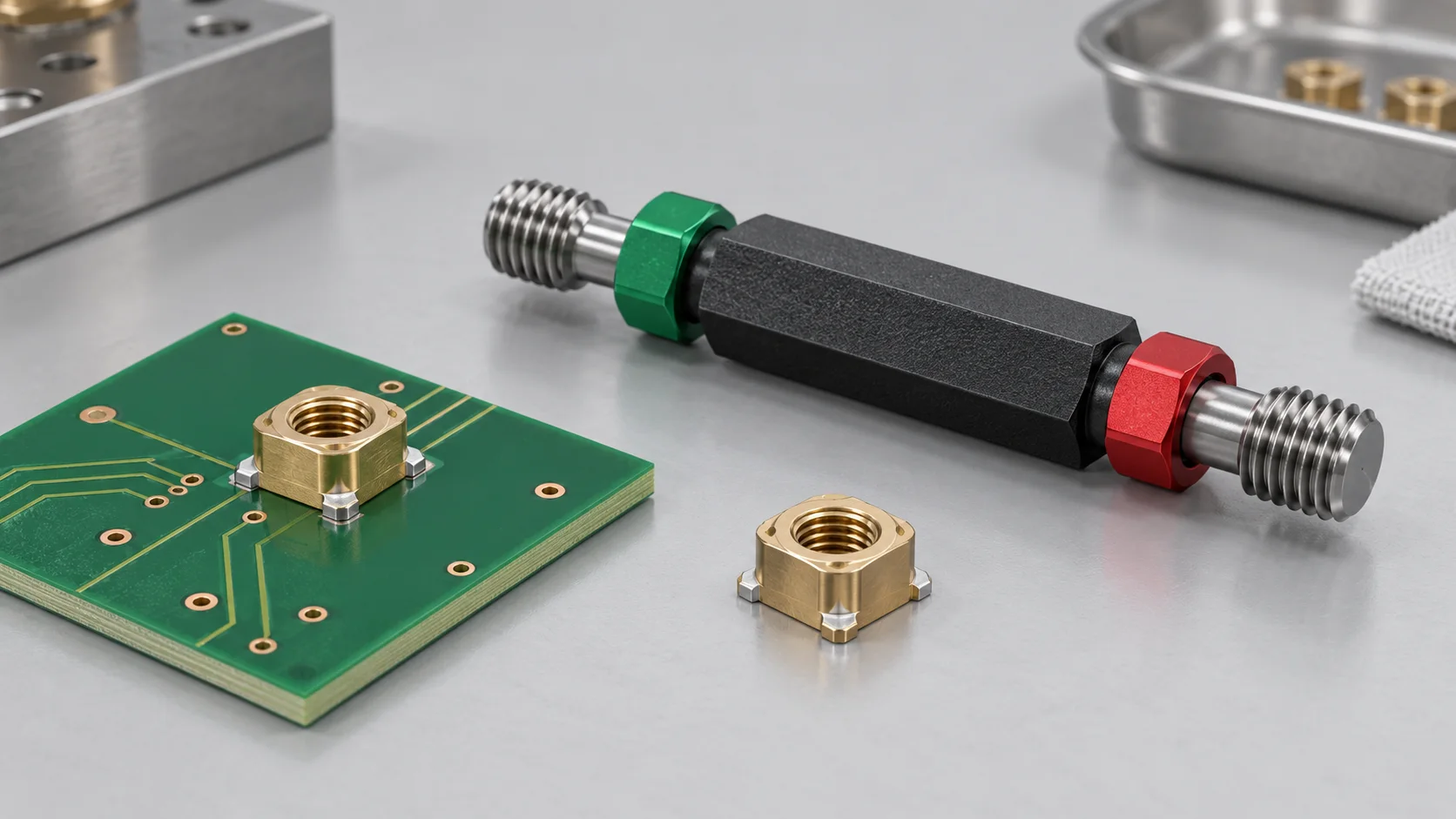
Direct answer A screw entering an SMT nut demonstrates assembly of that pair under those conditions. Dimensional thread acceptance requires matching GO and NO-GO gauges, with an agreed method and acceptance rule. Passing a gauge does not establish solder-joint strength, torque-out resistance or service life.
Complete the drawing before ordering gauges
ISO 1502:1996 covers gauges and gauging for general-purpose metric threads. Specify nominal diameter, pitch, tolerance class, effective threaded length and inspection state. Equal nut outside diameters do not imply equal internal threads. An unverified M3 or other size is a drawing request, not a claim that Hongchuan sells that SKU.
| Item to agree | Risk if missing |
|---|---|
| Diameter, pitch and tolerance class | A mismatched gauge produces misleading acceptance |
| Before plating, after plating or after reflow | Results from different stages are mixed |
| Effective length and entry chamfer | Short-thread or entry observations are misinterpreted |
| Gauge ID and calibration validity | Wear or out-of-tolerance effects cannot be traced |
Keep GO and NO-GO purposes separate
The GO member checks functional thread fit; the NO-GO member constrains the relevant upper dimensional limit. Apply the selected standard without forcing, adding tools or using the gauge to remove solder. Consult the applicable procedure for permitted NO-GO entry and short-thread treatment. Do not transfer a turn-count rule indiscriminately between thread systems.
If the GO gauge is obstructed, segregate the sample and record solder or residue at the entry and inside the thread. Use only an authorised rework procedure and retain before-and-after results. The related article discusses stencil and reflow checks for solder entering the thread.
A useful inspection record
Record lot, drawing revision, inspection stage, gauge IDs, GO outcome, observed NO-GO entry, photographs and disposition. Incoming inspection helps distinguish component issues; post-reflow inspection establishes whether assembly changed the usable thread. Agree sample size and acceptance separately; there is no universal sampling percentage here.
For an SMT nut enquiry, submit thread requirements, board thickness, soldering process and structural load. Keep dimensional acceptance and fastening validation as separate tasks.
Frequently asked question
Can one repeatedly used screw become the lot standard?
Its own dimensions, wear and surface condition affect the result. It is useful for assembly observations, but should not replace gauges configured to the agreed standard.
Sources
- ISO 1502 official scope.
- Northern Gauge GO/NO-GO explanation; use the applicable standard for detailed acceptance rules.
Sources checked on 8 October 2026. Calculations are hypothetical examples, not Hongchuan product test data. The cover is an AI-generated engineering illustration, not a product photograph or test record.