


Direct answer Estimate THR pin-in-paste volume from required solder volume, metal volume fraction and actual deposition. A 90% metal loading normally means mass fraction, not that 90% of the paste volume remains as solder after reflow. Check the specific paste data before sizing the stencil and print process.
Convert mass loading to volume fraction
Let metal mass fraction be w, alloy density ρmetal and flux-vehicle density ρvehicle. Neglecting mixture volume deviations, φ = (w/ρmetal)/[(w/ρmetal) + ((1 − w)/ρvehicle)]. Use w as a decimal and matching density units; φ is dimensionless.
Assume w = 0.90, ρmetal = 7.4 g/cm³ and ρvehicle = 1.0 g/cm³. Then φ is approximately 0.549. A target solder volume of 1.00 mm³ needs approximately 1.82 mm³ of deposited paste theoretically. The formulation and target volume are hypothetical. Indium's application note uses 7.4 g/cm³ in its alloy example and an approximate vehicle density of 1; obtain actual values for the selected paste.
Budget the space around the pin
For a round finished hole and round pin, free barrel volume is approximately π(Dhole² − dpin²)t/4. Use finished-hole diameter, pin diameter and board thickness in mm to obtain mm³. For a square pin, use its actual cross-sectional area. Apply the agreed barrel-fill target and add required fillet volume separately. The full hole volume is not all available for solder.
| Budget item | Required input |
|---|---|
| Target solder volume | Finished hole, pin, board thickness and joint requirements |
| Metal volume fraction | Mass loading and alloy/vehicle densities |
| Actual deposit | Aperture, stencil thickness and transfer performance |
| Process losses | Validated insertion displacement, slump and reflow loss |
Why aperture enlargement is not sufficient
Aperture volume is not the volume transferred on every print. Inspect deposited paste using SPI or a suitable weighing method, then verify the finished barrel using first-article sections or a validated inspection method. Phoenix Contact's THR guidance treats PCB layout, paste application and the actual reflow process as interacting conditions. Confirm whether a high-mass terminal is suitable for THR rather than changing the process based on shape alone.
For PCB solder terminal sourcing, provide the drawing, board thickness, hole and pin dimensions, paste and process requirements. The companion guide to solderability test selection helps distinguish wetting from assembly-volume issues.
Frequently asked question
Can every process use twice the final solder volume?
Approximately twice can be a starting estimate, but formulation, deposition and losses determine the actual ratio. Acceptance also needs an agreed joint class and inspection method; this article supplies no universal fill percentage.
Sources
- Indium application note, Calculating Solder Paste Usage.
- Indium metal loading explanation.
- Phoenix Contact SMT and THR guidance.
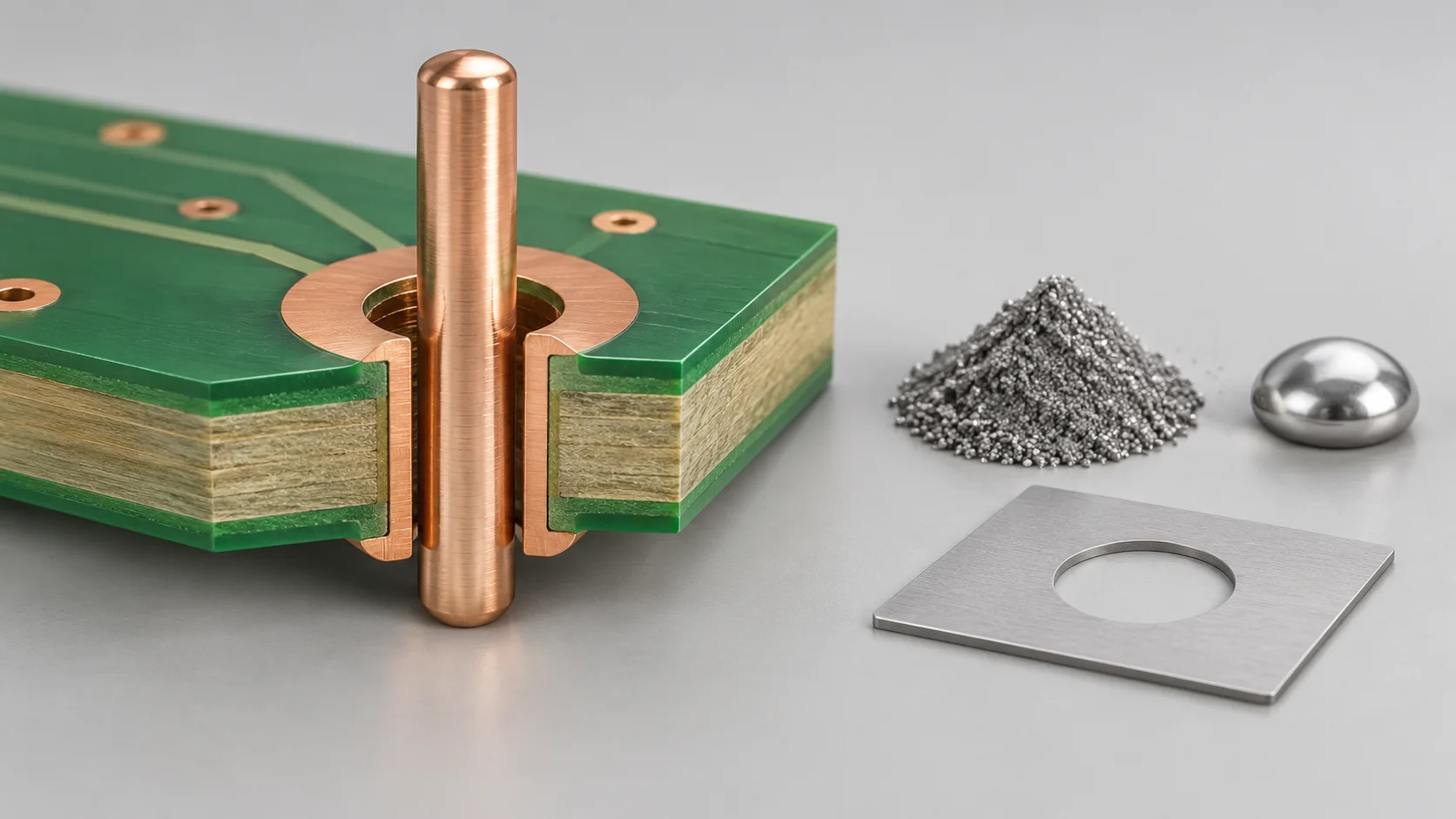
Sources checked on 8 October 2026. Calculations are hypothetical examples, not Hongchuan product test data. The cover is an AI-generated engineering illustration, not a product photograph or test record.