


%IACS in a PCB busbar material report compares conductivity with the International Annealed Copper Standard; it is not copper content. Match reference temperatures first. Using approximately 58 MS/m for 100%IACS at 20°C, σ in MS/m = 0.58 × p, where p is the numerical %IACS value. Resistivity is ρ = 1/σ after unit conversion.
Identify the specimen behind the number
A strip-material certificate, a formed-part measurement and a soldered PCB path are different records. Require a link to material batch, grade and condition. Material conductivity alone establishes neither solder-joint condition nor a busbar current rating.
NBS Copper Wire Tables, preserved by NIST, documents the annealed-copper reference and resistivity units. This 1966 handbook is used here for stable definitions and conversions, not as a current product acceptance specification.
Convert a hypothetical report
The table uses a common 20°C reference. The 80%IACS entry is hypothetical, not a Hongchuan result. 1 MS/m = 106 S/m; 1 μΩ·cm = 10−8 Ω·m; 1 Ω·mm²/m = 10−6 Ω·m.
| Quantity | 100%IACS reference, approximate | Hypothetical 80%IACS, approximate |
|---|---|---|
| Conductivity σ | 58 MS/m | 46.4 MS/m |
| Volume resistivity ρ | 1.7241 × 10⁻⁸ Ω·m | 2.1552 × 10⁻⁸ Ω·m |
| Same resistivity | 1.7241 μΩ·cm | 2.1552 μΩ·cm |
| For R = ρL/A | 0.017241 Ω·mm²/m | 0.021552 Ω·mm²/m |
80 × 0.58 gives 46.4 MS/m. Taking 1/(46.4 × 106) gives approximately 2.1552 × 10⁻⁸ Ω·m. With the last row, use L in meters and A in mm² for a uniform conductor. Do not substitute length in millimeters without conversion. Rounded table entries do not replace the precision and uncertainty of the original report.
Keep temperature and method together
FOERSTER's conductivity instrument explanation describes temperature compensation to 20°C. Determine whether a report gives an as-measured value or an already compensated reference value. Avoid compensating the same result twice.
Ask for instrument, calibration, specimen position and measurement method. For small, curved or plated parts, the testing party should explain method suitability. A reading on flat incoming strip is not automatically a measurement of each finished part.
Specify material and assembly requirements separately
Resistivity and dimensions can estimate the DC resistance of a uniform straight conductor. Section changes, bends and solder transitions require an actual path assessment. In a PCB busbar enquiry, distinguish material-report requirements from assembled-path resistance. See copper versus brass selection and resistance normalization to 20°C.
FAQ
Does 101%IACS mean more than 100% copper? No. It is a conductivity ratio to a historical reference, not chemical composition.
Is 46.4 MS/m equal to 46.4%IACS? No; it corresponds to 80%IACS using this reference.
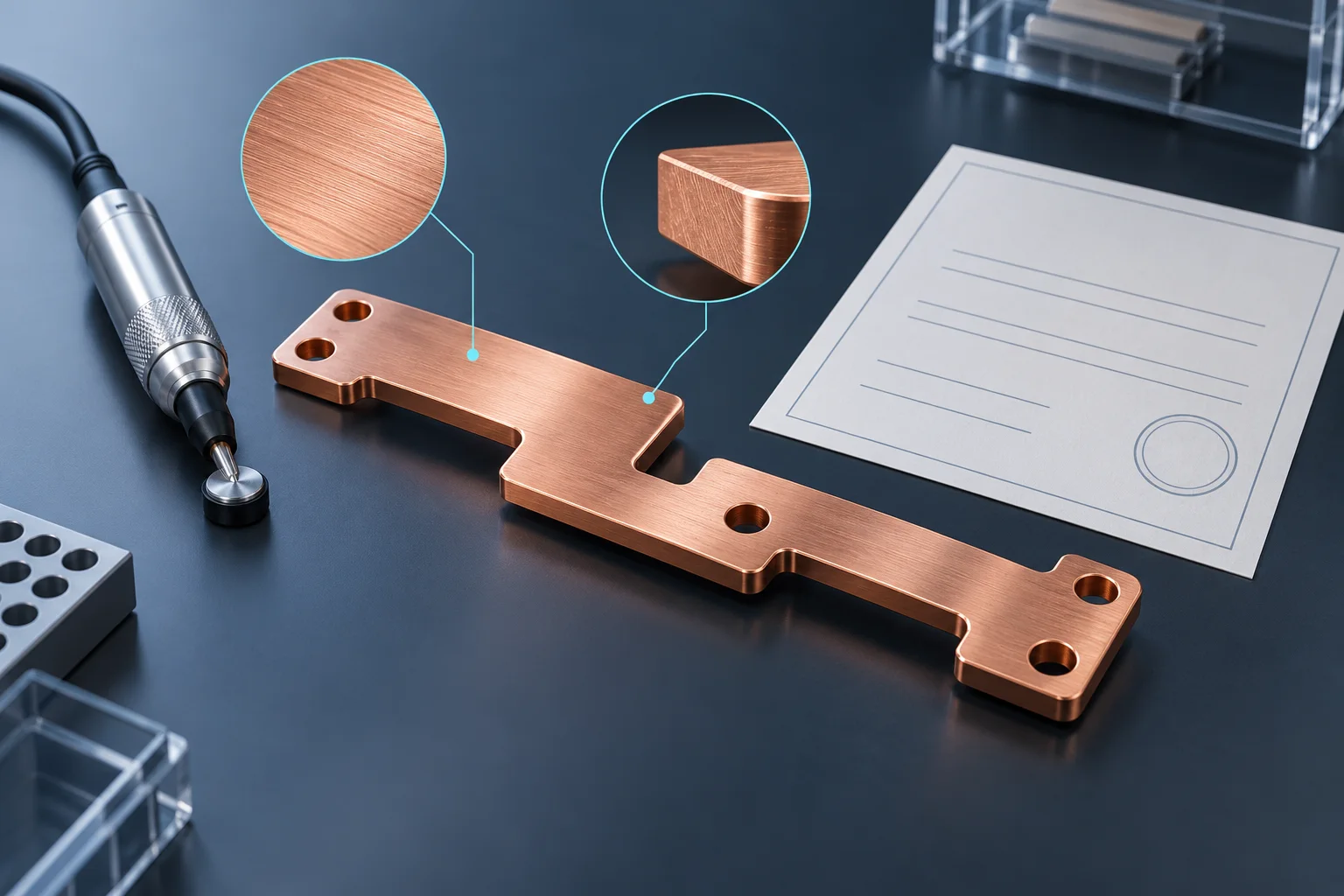
AI-generated material-inspection illustration, not a Hongchuan test report, facility or product photograph. The 80%IACS example is hypothetical and supplies no product rating or acceptance limit.